- MacBook Pro
- Use Rubymine for development
- Now using Selenium GRID 1.04
- Code base is Ruby leveraging the use of Rake
- VMware Fusion
- Team City
- Rally
In today's testing environment testers need to be agile, quick, and possess an arsenal of finely crafted tools. This blog is intended to share adventures through various open source tools and testing projects with a primary focus on Ruby, RSpec, Selenium RC, Selenium GRID, Cucumber and JMeter.
Saturday, September 19, 2009
Using Selenium GRID
Friday, June 26, 2009
JMeter to the Rescue
The time line was limited so there was not bandwidth for a coding effort nor to purchase any new tool.
We quickly turned to JMeter. This is going to be a short post, but there are a couple of key advantages we had with JMeter.
Observed advantages:
- JMeter out of the box could handle puts
- JMeter worked well with RAKE
- Fast installation and short learning curve
- Easily extensible
- Ability to run headless (no GUI) via RAKE
- Executing tests with the GUI dropped threads as load increased due to utilization of machine java processes
- graphic listeners are of extremely poor quality
- A single instance appears to be limited to approximately 300 concurrent threads
There are some key action items for me.
- Evaluate the ability to distribute load across several machines
- Evaluate the ability of JMeter to interact with Web-based applications (ajax stuff etc...)
- Develop Ruby scripts to calculate and report out data metrics as the number of transactions increase.
- Understand the limitations of this tool
- Evaluate other open source plugins developed for JMeter
Happy Testing!
Tuesday, June 09, 2009
Selenium RC plus RSpec
Friday, November 21, 2008
Kung Fu Testing
Not giving the phrase much thought at first, I liked it. After more thought I was pondering why would she draw the analogy of our testing style to that of Kung Fu. Was it because we did a good job of dissecting and targeting the critical risk areas to test or perhaps the long hours and dedication toward meeting the delivery date? Was it because out of self defense we effectively adjusted our testing strategy or was it the precision of the weapons selected to accomplish the task at hand?
I conclude that it was a little bit of everything stated above.
Dissection - We carefully chose to execute test cases and test plans in a precise order of risk.
Dedication – We worked into the wee hours of the morning for several nights in a row resurrecting our test environment.
Self Defense - We completed testing of all vital functions. We then executed regression test suites based on efficiency.
Weapons – Our WATIR framework allowed for some minor adjustments to the methods and we could readily execute the system regression tests.
We executed almost 600 test cases in only three days. Typically we allocate 5 days, but several days were needed to resurrect the testing lab. The precision in which the test plans were executed gave us the confidence to deliver the release on schedule. One test plan could not be executed, but we explained the risk in the release notes. After the delivery of the code we were able to execute this test plan further mitigating any risk.
Having recently completed the AST course Black Box Software Testing Foundations, I hope to expand upon this concept of Kung Fu Testing to be oracle and heuristic focused. There is always room for improvement, but accomplishments happen because of cultivating testing skills and hard work.
1 Wikipedia
Wednesday, July 23, 2008
To act or Not to Act
1. You are browsing the web.
2. You find a site, perhaps a major casino or an airline
3. The site is not user-friendly
4. Site has a major defect
Do you act an attempt to report the issue?
Or
No act and accept the flaw?
I am finding myself more and more documenting my experience and submitting it to the site. Which brings me to another point in that often it is difficult to find on the site the appropriate link to submit a defect.
Recently I sent a browser compatibility observation to a company and the CEO replied with a Thanks!
Comment and let me know what you would do.
Long live WATIR!
Friday, April 25, 2008
WATIR Fall
The most alarming aspect of this statement was that it was made as we were politely debating the use of QTP versus open-source testing tools. My first thought was, what does an old traditional development process have to do with tool selection?
It has been awhile since a single statement resonated with me over night.
In my view this statement implies that testing must wait until development is complete.
Approach to using QTP is record some GUI interactions and play them back. Next step might be to change values for some of the variables and repeat the test. Ideally the variables are pushed into a data table where the values can be read and a single test executed multiple times. If a tester or scripter is really curious they will look under the hood and find ways to improve the code generated by the record playback
In today’s world we are constantly hearing from management the key to success is time to market. I have seen numerous power points where these words appear. If testing waits until development is complete, then are we doing everything we can to get our products faster to the market?
Test automation should be considered throughout the process. The role of testing teams is to encourage testing from start to finish. Ideally test automation is being implemented in parallel to the development. Quality teams should be encouraging test driven development. As unit tests are being created, WATIR tests can be developed in advance of ever seeing the final code. Conversations take place with the developers and you can determine what an object on the UI is going to look like. Is it a radio button? If so ask the developer what tag name that radio button will have. Go write a test case in Ruby to test that radio button.
Really all you need to know that a requirement is going to be met on page X by implementing a radio button and you write:
assert(@ie.radio(:id, "requirement1").exists?)
@ie.radio(:id, "requirement1").set
Or
@ie.radio(:id, "requirement1").isSet
What else is on that page? There is a link. Is the link an image or something else? What is the name of the link? Where should the link take me? This can clearly be done in parallel with development.
@ie.link(:id, "loginButton").click
Client has a requirement that on this page there should be a certain warning message, so you write:
assert(@ie.contains_text('Danger Danger Will Robinson'))
These test cases took just a few seconds to write. Eventually these tests will need to be placed into a flow and executed, but the foundations can quickly be made from the requirements. Will this help get the software faster to the market? I certainly think so!
Large corporations need to shift the paradigm of long process water fall mentality to Smarter Faster Cheaper, Agile. Companies need to make their processed more agile and meet the demands of their clients by delivery better software fast.
Are there more complex tests than the few illustrated above? Absolutely!
This is where a team of testers collaborating can write extremely robust multi-purpose sets in Ruby. A quick example would be team A already has written some code to validate the content of an XML response. Team B needs to do the same thing, but for a different application. So the next step is to borrow the code and implement.
To be continued…
Thursday, March 06, 2008
Have you completed your Unit Tests?
Unit tests typically are written by the same developer who wrote the code. Perhaps corporations today expect that the software company conduct unit testing, then delivers the code to their contracted testing team.
Faster and cheaper certainly does not translate to a quality software product. There are many types of testing that should be conducted by experienced testing teams before deliverying code to the clients. Exploratory testing cannot be executed by a JUnit test. Integration testing or performance testing and GUI testing cannot be easily implemented by JUnit.
When companies now ask "Did you complete your unit testing?", my answer is always yes we have tested our software.
Tuesday, September 04, 2007
Fantastic Community
The community is fantastic and quickly responded with several approaches. I will be honest in that I did not understand some of them, but somehow the responses inspired me to get the code working. Brett asked that I share some snippets of code, so I thought I would post them here.
Before I do that I also need to mention my mistake. When I posted to the forum I really did not include enough information. I was a bit concerned about the proprietary nature of the code, so I only posted a tiny portion of our code. I should have reworked the code and posted the entire script. Please when you post include as much information as possible so these brilliant people can respond appropriately.
Warning there is a lot of code.
Here is an example of what the original code looked like:
# Script is designed to execute Smoke test test cases
#
#
#Initials Date Summary
#CLS 10/04/05 Checked in first draft
#CLS 12/02/05 Clean up/Site Selection code
#List of to do's or ideas for improvement
#
# BEGIN -
#includes:
require 'watir' # the watir controller
require "rexml/document"
require "date"
require '/apps/ruby/lib/ruby/1.8/test/unit'
require '/apps/ruby/lib/ruby/1.8/test/unit/ui/console/testrunner'
require 'watir/testUnitAddons'
require 'watir/WindowHelper'
include REXML
include Watir
puts "## Begin Test - DN Advanced flow"
class SmokeTest < Test::Unit::TestCase
include Watir
def setup
@ie = IE.new
@ie.goto($URL)
end
def startClicker( button , waitTime = 3)
w = WinClicker.new
longName = @ie.dir.gsub("/" , "\\" )
shortName = w.getShortFileName(longName)
c = "start rubyw #{shortName }\\watir\\clickJSDialog.rb #{button } #{ waitTime} "
puts "Starting #{c}"
w.winsystem(c)
w=nil
#assert_same(expected, actual, [message] ) #Expects expected.equal?(actual)
end
def test1
# User enters login information and test validates assertions
assert(@ie.text_field(:id, "Person.username").exists?)
assert(@ie.text_field(:id, "Person.password").exists?)
assert(@ie.link(:id, "loginButton").exists?)
@ie.text_field(:name, "Person.username").set($Username)
@ie.text_field(:name, "Person.password").set($Password)
# User submits login information
@ie.link(:id, "loginButton").click
# User chooses application flow
@ie.image(:src , /ps_header_module_solution_builder_iconUp.gif/).click
# User selects an Account
@ie.selectBox( :name , "NS_Account").select("Basic Training")
# User Sets specific solution name
@ie.text_field(:name, "NS_Title").set("Test1")
# User selects Long Distance Voice check box
@ie.checkBox(:id, "DN").set
assert(@ie.checkbox(:id, "DN").isSet?)
# User selects LD advanced mode
@ie.radio(:id, "advDN_mode").set
assert(@ie.radio(:id, "advDN_mode").isSet?)
# User advances to Solution Status Page
@ie.link(:id, "next").click
# User moves to Site Selection Page
@ie.link(:id, "next").click
# User clears the selection of all sites
@ie.image(:id, "selectAllButton").click
# Selects specific sites
assert( @ie.cell(:id, '001-TX-AUS').exists? )
@ie.cell(:id, '001-TX-AUS').checkbox(:index,1).set
@ie.cell(:id, '002-TX-DAL').checkbox(:index,1).set
# User moves to Sol. Status Page
@ie.link(:id, "next").click
# User deselects technologies
@ie.checkBox(:id, "Frame RelayTECHNOLOGIES").click
# @ie.checkBox(:id, "IVPN CPETECHNOLOGIES").click
@ie.radio(:id, "2_answer").set
# User moves to AME Page
@ie.link(:id, "next").click
# User adds a Local Access
@ie.link(:text, "ADD NEW...").click
@ie.link(:text, "LOCAL ACCESS").click
ie2 = IE.attach(:title, "Local Access")
ie2.selectBox( :name , "loopType").select("Access Link")
ie2.selectBox( :name , "loopSitesAvailable").select("001-TX-AUS")
ie2.selectBox( :name , "loopSitesAvailable").select("002-TX-DAL")
ie2.image(:src , /ps_transferto_button.gif/).click
ie2.image(:src , /ps_save_button.gif/).click
assert(@ie.contains_text('Technology: Access Link - 1.5 Mbps '))
assert( @ie.image(:src , /ps_icon_local_loop.gif/).exists? )
# User adds a port
@ie.link(:text, "ADD NEW...").click
@ie.link(:text, "PORT").click
ie2 = IE.attach(:title, "Port")
ie2.selectBox( :name , "portLoop").select("local access 0")
ie2.selectBox( :name , "portType").select("myport")
ie2.selectBox( :name , "portSitesAvailable").select("001-TX-AUS")
ie2.selectBox( :name , "portSitesAvailable").select("002-TX-DAL")
ie2.image(:src , /ps_transferto_button.gif/).click
ie2.image(:src , /ps_save_button.gif/).click
assert(@ie.contains_text('myPort '))
assert( @ie.image(:src , /ps_icon_local_loop_with_port.gif/).exists? )
# User adds a connection
@ie.link(:text, "ADD NEW...").click
@ie.link(:text, "CONNECTION").click
ie2 = IE.attach(:title, "Connection")
sleep 2
ie2.selectBox( :name , "connPort1").select("port 0")
ie2.selectBox( :name , "connSitesAvailable1").select("001-TX-AUS")
ie2.image(:src , /ps_transferto_button/).click
ie2.selectBox( :name , "connPort2").select("port 0")
ie2.selectBox( :name , "connSitesAvailable2").select("002-TX-DAL")
ie2.link(:url, /connSitesAvailable2/).click
ie2.selectBox( :name , "Bandwidth").select("256.0 kbps")
ie2.selectBox( :name , "connType").select("Standard 256kbps")
ie2.image(:src , /ps_save_button.gif/).click
assert(@ie.contains_text('Standard 256kbps'))
assert( @ie.image(:src , /ps_icon_local_loop_with_port_and_connection.gif/).exists? )
# User moves to Solution Status Page
@ie.link(:id, "next").click
# User moves to Recommedations Page
@ie.link(:id, "next").click
# User moves to Compare Services Page
@ie.link(:id, "next").click
# User moves to General options Page
@ie.link(:id, "next").click
# User moves to Per Site Options Page
@ie.link(:id, "next").click
# User moves to Proposed Solution Page
@ie.link(:id, "next").click
# User saves the solution
@ie.link(:title, "Suspend and save this solution...").click
# # User logouts out of the application
startClicker("OK" , 3) # click the OK button after 3 seconds
sleep 3
@ie.link(:text, "Logout").click
# Closing Browser instance
@ie.close
#
end
end
Here is what the new code looks like:
# Script is designed to execute ATM Smoke test test cases
#
#
#Initials Date Summary
#CLS 10/04/05 Checked in first draft
#CLS 12/02/05 Clean up/Site Selection code
#CLS 08/31/07 Refactored code
#List of to do's or ideas for improvement
#
# BEGIN -
#includes:
require 'watir' # the watir controller
require "rexml/document"
require "date"
require '/apps/ruby/lib/ruby/1.8/test/unit'
require '/apps/ruby/lib/ruby/1.8/test/unit/ui/console/testrunner'
require 'watir/testUnitAddons'
require 'watir/WindowHelper'
require '/SCPTTest/test/Functional/Project1'
include REXML
include Watir
include Project1
include Navigation
puts "## Begin Test - Test1"
puts "## Executes Test cases on SmokeTest Plan"
class Refactor < Test::Unit::TestCase
def test1
@ie = IE.new
@ie.goto("http://localhost:8080/scp/index.jsp")
Login("42","42")
# Prime modes - DN, LD, DIA
# Seconday modes - guidedDIA_mode, advDIA_mode, guidedLD_mode, advLD_mode, guidedDN_mode, advDN_mode
selectAccountModules("Ace Marketing","DNX_ATM_XX","DN","advDN_mode")
selectSites("Dallas Office","Houston Office")
deselectTechnology("Frame RelayTECHNOLOGIES","2_answer")
addAccess("Access Link - 1.5 Mbps","Dallas Office","Houston Office","BOB")
addPort("Port -.536 Mbps:UNI","Dallas Office","Houston Office","BOB")
addConnection("Dallas Office","Houston Office","256.0 kbps","Standard 256kbps","BOB")
quickNavigation()
logout()
end
end
Here are the methods in the module:
# This module provides access to the various data sources used by RPA
# It is designed to make it easier to write RPA functional tests
# Most of the information we need to test RPA is in XML files,
# This module uses REXML to parse the XML.
# REXML is available at http://www.germane-software.com/software/rexml/
require 'watir' # the watir controller
require "rexml/document"
require "date"
require '/apps/ruby/lib/ruby/1.8/test/unit'
require '/apps/ruby/lib/ruby/1.8/test/unit/ui/console/testrunner'
require 'watir/testUnitAddons'
require 'watir/WindowHelper'
require '/projectpath/test/Functional/Project1'
include REXML
include Watir
# This is a module, which can be used Ruby applications and tests.
# To make this module available to your test, add two lines to the file:
# require "Project2"
# include Project2
# There is no need for the test to require or include REXML.
module Project2
require 'watir'
include Watir
# The CatalogData class loads, parses and provides access to the
# PowerSeller catalog XML file, which is how out-of-the-box stores
# product information
class CatalogData
#The constructor for CatalogData takes two strings:
# - scp_dir: the directory where Project2 is installed
# - file: the name of the catalog file, usually 'devCatalogSupplement.xml'
#It creates a REXML Document and assigns it to the instance variable @catalogDoc
def initialize(scp_dir, file)
catalogFile = File.new(scp_dir + "/data/" + file)
@catalogDoc = Document.new catalogFile
end
#Takes a string id, and returns the catalog item with that id, if it
#exists - nil otherwise.
def getItemById(id)
@catalogDoc.elements["catalog/catalogData/item[@id=" + id + "]"]
end
#Returns the string value of the name of the catalog
def getItemName(item)
item.elements["name"].text
end
#Takes a plan element and returns an attribute by Id
def getItemAttributeById(item,id)
item.elements["attributeValue[@attributeId=" + id + "]"]
end
#Takes a plan element and returns the contained price element
def getPlanPriceData(plan)
priceInfo = plan.elements["attributeValue[@attributeId='108']"].cdatas[0].to_s
priceDoc = Document.new priceInfo
end
#Takes a plan and term, and returns a Hash of the pricing info for that plan
#at that term (in months) for the default price sheet
def getTermPrice(plan,term)
priceDoc = getPlanPriceData(plan)
termPriceElement = priceDoc.elements["price/price/dateRange/term[@length=" + term.to_s + "]/discountable"]
termPrice = {"mrc" => termPriceElement.attributes["mrc"].to_f,"nrc" => termPriceElement.attributes["nrc"].to_f }
end
#Takes a string id and returns the string name of that provider
def getProviderById(id)
@catalogDoc.elements["catalog/catalogData/provider[@id=" + id + "]"]
end
end
class Currency
def initialize(float)
@value = float
end
def to_s
currency = @value.to_s
s = sprintf( "%3.2f", currency )
return "$" + s
end
end
# The Table class provides convenience methods for accessing data in
# WATIR tables
class Table
#The constructor for Table takes a WATIR table and
# assigns it to the instance variable @table
def initialize(table)
@table = table
end
#Takes a string and two integers. Returns the contents of
# the table cell at the index of the second integer for the
# row where the string is in the cell at the index of the
# first integer.
# Example: myTable.assoc("findMe",2,4) finds the row of
# the table where the text "findMe" is in the second column,
# and returns the contents of the 4th column
def assoc(text,rowFinder,targetCell)
@table.each { row
if row[rowFinder].to_s.include? text
return row[targetCell].to_s
end
}
return nil
end
def printPretty()
rows = 0
@table.each { row
rows += 1
puts "row " + rows.to_s + ":"
print "\t"
cells = 0
row.each { cell
cells += 1
print "cell " + cells.to_s + ": [" + cell.to_s + "]\t"
}
print "\n"
}
puts "-----------------------------------------------------------------------------------------"
end
end
# This module is intended to provide generic methods for navigation through the PowerSeller application
module Navigation
def startClicker( button , waitTime = 3)
w = WinClicker.new
longName = @ie.dir.gsub("/" , "\\" )
shortName = w.getShortFileName(longName)
c = "start rubyw #{shortName }\\watir\\clickJSDialog.rb #{button } #{ waitTime} "
puts "Starting #{c}"
w.winsystem(c)
w=nil
#assert_same(expected, actual, [message] ) #Expects expected.equal?(actual)
end
#Login for any PowerSeller application
def scpLogin(user,password)
assert(@ie.text_field(:id, "Person.username").exists?)
assert(@ie.text_field(:id, "Person.password").exists?)
# puts "my first variable is " + user
# puts "my second variable is " + password
@ie.text_field(:name, "Person.username").set(user)
@ie.text_field(:name, "Person.password").set(password)
@ie.link(:id, "loginButton").click
end
# Select account and modules
def selectAccountModules(account,solutionName,primemode,secmode)
@ie.image(:src , /ps_header_module_solution_builder_iconUp.gif/).click
@ie.selectBox( :name , "NS_Account").select(account)
@ie.text_field(:name, "NS_Title").set(solutionName)
@ie.checkBox(:id, primemode).set
assert(@ie.checkbox(:id, primemode).isSet?)
@ie.radio(:id, secmode).set
assert(@ie.radio(:id, secmode).isSet?)
@ie.link(:id, "next").click
assert(@ie.contains_text(solutionName))
@ie.link(:id, "next").click
end
#Select sites
def selectSites(site1,site2)
startClicker("OK" , 5)
@ie.image(:id, "selectAllButton").click
assert( @ie.cell(:id, site1).exists? )
@ie.cell(:id, site1).checkbox(:index,1).set
@ie.cell(:id, site2).checkbox(:index,1).set
@ie.link(:id, "next").click
end
def selectFiveSites()
mydata.length
startClicker("OK" , 5)
@ie.image(:id, "selectAllButton").click
assert( @ie.cell(:id, site1).exists? )
@ie.cell(:id, site1).checkbox(:index,1).set
@ie.cell(:id, site2).checkbox(:index,1).set
@ie.cell(:id, site3).checkbox(:index,1).set
@ie.cell(:id, site4).checkbox(:index,1).set
@ie.cell(:id, site5).checkbox(:index,1).set
@ie.link(:id, "next").click
end
def deselectSites(site1,site2)
@ie.link(:id, "back").click
assert(@ie.cell(:id, site1).checkbox(:index,1).isSet?)
assert(@ie.cell(:id, site2).checkbox(:index,1).isSet?)
@ie.cell(:id, site1).checkbox(:index,1).clear
assert_false(@ie.cell(:id, site1).checkbox(:index,1).isSet?)
@ie.cell(:id, site2).checkbox(:index,1).clear
assert_false(@ie.cell(:id, site2).checkbox(:index,1).isSet?)
end
def toggleTermButtons()
assert(@ie.radio(:id, "36ContractTerm").isSet?)
@ie.radio(:id, "12ContractTerm").set
assert(@ie.radio(:id, "12ContractTerm").isSet?)
@ie.radio(:id, "1ContractTerm").set
assert(@ie.radio(:id, "1ContractTerm").isSet?)
assert_false(@ie.radio(:id, "24ContractTerm").isSet?)
@ie.radio(:id, "24ContractTerm").set
assert(@ie.radio(:id, "24ContractTerm").isSet?)
assert_false(@ie.radio(:id, "12ContractTerm").isSet?)
end
# DIA Needs Analysis pages for guided mode
def diaAnalysis()
@ie.link(:id, "next").click
end
def diaPreferences(tech1)
# @ie.checkBox(:id, tech1).click
@ie.link(:id, "next").click
end
def deselectTechnology(tech1,premier)
@ie.checkBox(:id, tech1).click
@ie.radio(:id, premier).set
@ie.link(:id, "next").click
end
def selectNVPN(tech1)
@ie.checkBox(:id, tech1).click
@ie.link(:id, "next").click
end
def selectDefaultTechnologies()
@ie.link(:id, "next").click
end
def addAccess(access,site1,site2,assert)
@ie.link(:text, "ADD NEW...").click
sleep 2
@ie.link(:text, "LOCAL ACCESS").click
sleep 2
ie2 = IE.attach(:title, "Local Access")
ie2.selectBox( :name , "loopType").select(access)
ie2.selectBox( :name , "loopSitesAvailable").select(site1)
ie2.selectBox( :name , "loopSitesAvailable").select(site2)
ie2.image(:src , /ps_transferto_button.gif/).click
ie2.image(:src , /ps_save_button.gif/).click
sleep 4
assert(@ie.contains_text(assert))
# assert( @ie.image(:src , /ps_icon_local_loop.gif/).exists? )
end
def addPort(port,site1,site2,assert)
@ie.link(:text, "ADD NEW...").click
sleep 2
@ie.link(:text, "PORT").click
sleep 2
ie2 = IE.attach(:title, "Port")
ie2.selectBox( :name , "portLoop").select("local access 0")
ie2.selectBox( :name , "portType").select(port)
ie2.selectBox( :name , "portSitesAvailable").select(site1)
ie2.selectBox( :name , "portSitesAvailable").select(site2)
ie2.image(:src , /ps_transferto_button.gif/).click
ie2.image(:src , /ps_save_button.gif/).click
sleep 2
assert(@ie.contains_text(assert))
assert( @ie.image(:src , /ps_icon_local_loop_with_port.gif/).exists? )
end
def addServicePlan(domestic,mac,international,site1,site2,assert1,assert2)
@ie.link(:text, "ADD NEW...").click
@ie.link(:text, "SERVICE PLAN").click
ie2 = IE.attach(:title, "Service Plan")
ie2.selectBox( :name , "servicePort").select("port 0")
ie2.selectBox( :name , "domesticServiceType").select(domestic)
ie2.selectBox( :name , "domesticServiceMacLevel").select(mac)
ie2.selectBox( :name , "internationalServiceType").select(international)
ie2.selectBox( :name , "internationalServiceMacLevel").select(">= 0")
ie2.selectBox( :name , "serviceSitesAvailable").select(site1)
ie2.selectBox( :name , "serviceSitesAvailable").select(site2)
ie2.image(:src , /ps_transferto_button.gif/).click
ie2.image(:src , /ps_save_button.gif/).click
assert(@ie.contains_text(assert1))
assert(@ie.contains_text(assert2))
# assert( @ie.image(:src , /ps_icon_local_loop_with_port.gif/).exists? )# User moves to Solution Status Page
end
def addConnection(site1,site2,speed,connection,assert)
@ie.link(:text, "ADD NEW...").click
sleep 2
@ie.link(:text, "CONNECTION").click
sleep 2
ie2 = IE.attach(:title, "Connection")
ie2.selectBox( :name , "connPort1").select("port 0")
ie2.selectBox( :name , "connSitesAvailable1").select(site1)
ie2.image(:src , /ps_transferto_button/).click
ie2.selectBox( :name , "connPort2").select("port 0")
ie2.selectBox( :name , "connSitesAvailable2").select(site2)
ie2.link(:url, /connSitesAvailable2/).click
ie2.selectBox( :name , "Bandwidth").select(speed)
ie2.selectBox( :name , "connType").select(connection)
ie2.image(:src , /ps_save_button.gif/).click
sleep 2
assert(@ie.contains_text(assert))
assert( @ie.image(:src , /ps_icon_local_loop_with_port_and_connection.gif/).exists? )
end
def addProductBundle(bundletype,bundle,site1,site2,assert)
@ie.link(:text, "ADD NEW...").click
@ie.link(:text, "PRODUCT BUNDLE").click
sleep 10
ie2 = IE.attach(:title, "Product Bundle")
assert(ie2.selectBox(:name, "bundleType").exists?)
assert(ie2.selectBox(:name, "bundleType").enabled?)
ie2.selectBox( :name , "bundleType").select(bundletype)
ie2.selectBox( :name , "bundleItem").select(bundle)
ie2.selectBox( :name , "bundleSitesAvailable").select(site1)
ie2.selectBox( :name , "bundleSitesAvailable").select(site2)
ie2.image(:src , /ps_transferto_button.gif/).click
ie2.image(:src , /ps_save_button.gif/).click
sleep 4
assert(@ie.contains_text(assert))
assert( @ie.image(:src , /ps_icon_local_loop_with_port_and_connection.gif/).exists? )
end
def quickNavigation()
@ie.link(:id, "next").click
@ie.link(:title, "Suspend and save this solution...").click
end
def diaNavigation()
@ie.link(:id, "next").click
sleep 2
@ie.checkBox(:id, "sol_0").click
@ie.link(:id, "next").click
@ie.link(:title, "Suspend and save this solution...").click
end
def logout()
startClicker("OK" , 3) # click the OK button after 3 seconds
sleep 3
@ie.link(:text, "Logout").click
@ie.close
end
end
end
If you have questions please let me know.
Wednesday, February 07, 2007
Viewing data in a Table
I typically evaluate are tables in this manner.
@ie.show_tables
The I pick the table I believe contains the data I am attempting to access and call this method:
@Table.new(@ie.table(:index, 40)).printPretty
Print Pretty code is placed in a library file and I require it for the scripts that need to evaluate tables.
Here is an example as to how you could use this.
Create a file called MSNTest.rb with this code:
# CLS February 7,2007 Example for finding table data
#includes:
require 'watir' # the watir controller
require "rexml/document"
require "date"
require '/apps/ruby/lib/ruby/1.8/test/unit'
require '/apps/ruby/lib/ruby/1.8/test/unit/ui/console/testrunner'
require 'watir/testUnitAddons'
require 'watir/WindowHelper'
require '/Apps/watir_bonus/examples/Stuff.rb'
include REXML
include Watir
include Stuff
puts "## Begin Test - MSN Table Test"
class MSN_Test < Test::Unit::TestCase
include Watir
def setup
@ie = IE.new
@ie.goto("http://www.msn.com")
end
def test1
assert(@ie.link(:text, "Sports").exists?)
# @ie.show_all_objects
@ie.show_tables
Table.new(@ie.table(:index, 1)).printPretty
end
end
#
#
# END - MSN test
In the same directory create a file called Stuff.rb with this code:
# This module uses REXML to parse the XML.
# REXML is available at http://www.germane-software.com/software/rexml/
require "rexml/document"
require "date"
include REXML
# There is no need for the test to require or include REXML.
module Stuff
# The Table class provides convenience methods for accessing data in
# WATIR tables
class Table
#The constructor for Table takes a WATIR table and
# assigns it to the instance variable @table
def initialize(table)
@table = table
end
#Takes a string and two integers. Returns the contents of
# the table cell at the index of the second integer for the
# row where the string is in the cell at the index of the
# first integer.
# Example: myTable.assoc("findMe",2,4) finds the row of
# the table where the text "findMe" is in the second column,
# and returns the contents of the 4th column
def assoc(text,rowFinder,targetCell)
@table.each { |row|
if row[rowFinder].to_s.include? text
return row[targetCell].to_s
end
}
return nil
end
def printPretty()
rows = 0
@table.each { |row|
rows += 1
puts "row " + rows.to_s + ":"
print "\t"
cells = 0
row.each { |cell|
cells += 1
print "cell " + cells.to_s + ": [" + cell.to_s + "]\t"
}
print "\n"
}
puts "-----------------------------------------------------------------------------------------"
end
end
end
Execute the MSNTest..rb script to see the results of the content of the table on the MSN home page. This site happens to only have one table, but if there were multiple tables just use the index value of the table your target data resides (Table.new(@ie.table(:index, ??)).printPretty).
Enjoy!
Friday, January 26, 2007
Trip Report for AWTA
The information below outlined italics is intended to be from my perspective, including tangent thoughts during the conference.
The first think worth note is the meeting format. The meeting took on its own flavor of LAWST meeting style.
Meeting began with brief introductions round table, stating who you are and what you hope to gain from workshop.
Next a participant gave an experience report. Each person at the workshop was given a green, purple, and pink index card. During the experience report the only questions permitted are clarifying questions. If it is not a clarifying question the facilitator will move the report forward and table the question. After the experience report it becomes “Open Season”. Here is where the cards come into play. If you have a question or comment regarding the report you hold up your green card and the facilitator puts your name on a list. If a discussion is going on and you want to add input you hold up the purple card. If you think a topic has deviated from the topic or you think it has been beat to death you raise the pink card. This format is a very good means to keep a meeting on topic and permit everyone to participate.
The first experience report was presented by Jean McAuliffe. She previously had worked for Rational and had gotten tired of the rigorous process. She went to work for a start up that used Agile techniques. She fell in love with the approach and began using an open source tool called Fitnesse. This tool is based on an open-source project called Fit.
This is a tool that can allow the team to test without the GUI. Column based data from a Wiki page are fed into fixtures created by the developers. This is a cool way to test, but I am not sure it is appropriate for us. In my opinion we need to have Unit Test coverage and a more robust UI testing suite.
Jean explained how she left this agile team to lead a start up. All of the effort was sweat equity and she found it difficult to implement Fitnesse, because the developers did not want to spend time writing the fixtures. These tools are unique in that there are no tools like it on the open market. Sometimes test work fine in Fitnesse, but then fail at the GUI level. The Fit discussions lead Paul Roger’s and others to begin talking about the difficulties of open source tools. “What would make open-source tools easier to use? Some responses included:
- More concrete or real world examples
- More Peer help
- Better documentation
- Documented in different ways to serve a wider audience
- Identify and bring in Tool Smiths
Brian Marick added that consumer of tools needed
- Direct communication to the experts
- Developers to have a good attitude toward Newbies
- Acknowledgement to members who submit quality defects
- Perhaps documentation similar to Wikapedia, but can only add content and not edit the original content. A place where clarifications, struggles, and resolutions can be entered.
- Concept of having a "WATIR buddy" – paired test programming
Danny Faught the context school of testing and the importance of Agile.
It is a real puzzle to the testing community as to what tools should be used. One example is WATIR versus Selenium. Potentially Selenium RC has offered an improvement. Selenium uses HTML tables and is not re-factorable. Selenium RC comes with API’s to plug into using Ruby. There was a ton of conversation around how to make open-source tools better and I unfortunately did not capture it all.
A point of clarification or realization for me was that WATIR was developed for IE only. Teams were leaning toward Selenium where multi-browser support is required. There are new projects Fire WATIR and Safari WATIR to assist with other browsers.
Another observation about this workshop format was the use of GIANT Post it pads. Concepts were written down by scribes and posted all over the room for future elaboration and discussion. This was a pretty cool way to capture the concepts.
The next portion of the meeting was very interesting. They referred to it as “Brain Storming”. This was an hour long whirlwind of problems and ideas around the topic “Costs, Limitations, and Improving Test Frameworks”.Next experience report came from Bob Cotton of Rally. Bob showed some of the work they were doing using RSpec, which is behavior driven development versus test-driven development. He referenced Mike Cohn’s testing pyramid.

Fit or Fitnesse is typically used to test the middle layer. JUnit is typically used for the Unit Test. And WATIR for the UI portion. I got the sense that the Acceptance portion is expected to be executed without the UI and consists of direct testing of business objects. Testing should be done proportionally with the most being Unit Testing, less Acceptance and even less UI. The other interesting comment was that he drew a tiny circle above the period indicating the amount of manual testing that should take place.
Bob talked about an approach where the things you do not have time to do should be doe first. How are you going to test should be the focus and not how are you going to build. He talked about doing functional test and acceptance testing through the GUI via a layer of abstraction.
He used Ruby to build a set of new methods that would be leveraged in Selenium (i.e. – attr_reader and attr_writer). Test suites then run nightly and they typically take about 3 hours.He talked about behavior-driven development using RSpec which followed the pattern of state the setup/context (state of the world), specify (action), and teardown/end (close the test).
His code was based on Ruby (which out of the box has an XML parser), Selenium RC, RSpec, Test::Unit, and proprietary code.
There agile approach is to understand the story, then determine how to test the story.
- What are the acceptance tests?
- Unit tests should be XYZ
- Functional tests should be ABC
I really liked structuring the test cases with the RSpec format: set up, do, teardown format.
Example:
context "BDD framework" do
setup do
@bdd_framework = BddFramework.new
end
specify "should be adopted quickly" do
@bdd_framework.should_be_adopted_quickly
end
specify "should be intuitive" do
@bdd_framework.should_be_intuitive
end
end
Fit has the ability to test the acceptance layer of the Testing Pyramid. What would replace Fit?
New tools need to be developed to exercise the middle layer (e.g. – JRuby). Brian had some comments. He stated that he agrees that Domain Specific Language (DSL) is important. DSL is a programming language designed to be useful for a specific set of t
Brian discussed Business facing tests.
- Tests of Business logic
- Workflows through the system
- Presentation tests - UI- How does it look to a person?
A Fit table does this by describing the way the system works. He proposed pick up the look and feel of a page and turn it into an automated test using Ruby. He gave a brief demonstration of code and it was a very unique way to test page views.
At this point it occurred to me how important it would be to test PowerSeller in IE7 before our clients ask for it. I set this as an action item for myself.
Next another interesting format to this workshop took place called “Open Spaces”. Basically everyone in the room could toss out ideas of things they wanted more information on or things they wanted to present to those interested. Many topics are place on cards and taped to the wall. After the topic session was complete someone would grab a topic and head to the corner of a room. Essentially people would vote with there feet and go to the topic they were interested in.
I chose to participate in the discussion of creating a Common Browser driver that supported both WATIR and Selenium. The other discussions in the room focused on What it means to be a Tool Smith and a Custom JavaScript project.
Bret Pettichord and Bob Cotton did most of the work and discussion on the common driver. The group split into two groups when Paul Rogers decided to focus on his new approach to test automation called RUMBA.
RUMBA in a nutshell is a framework that places a tiny piece of flash code on every web page, then flash is used as the testing framework. Unfortunately I do not understand the specifics, but I think it has great potential.
Developing the common driver was an interesting topic. From my perspective I wondered why bother since other WATIR projects are moving ahead full steam to test other browsers. The collaboration between Bret and Bob was fun to watch. My take away was a style of coding and two books were recommended, Ruby Cookbook and Programming Ruby. As they were collaborating, Brain Marick stopped by the group and suggested the name for the project, Mineral WATIR.
Miscellaneous tools were mentioned:
SYSTIR – I believe this is a domain specific language using Ruby
WATIR::Simple – I believe this is also intended as a DSL.
Tclockexe – Can change the format of your machine clock. Good for dating screen shots.
PrintDesktop.com – Allows you to send a snapshot of your desktop directly to a printer. One advantage would be if your machine freezes and you want to show IT the state.XPlanner – open source project management tool
We received a summary report of the Tool smith discussion.
Someone mentioned we should read an article by Eric Raymond. Look to works by James Bach on the definition of a good test. Also check out an innovative company called Atomic Object. Carl Erickson and David Crosby were at the AWTA.
Next was another really cool format used during the workshop, “Lightning Talks”. Basic format is that anyone can speak, but they only have 5 minutes to make their point.
Chris McMahon took the lead with his talk on Better Marketing for Open Source tools. High energy pitch on how software should be represented today. Software development is not a factory and not as described by structuralists. Software is not engineering or manufacturing. Software involves unity, complexity, and variety. Today software is a craft and a discipline. Using the language of art, music, and culture is the best way to talk about software.
Al Snow then talk about “User Groups Internal to a Company” introducing FIT at his company. They formed internal user groups and held routine meet ups to discuss FIT. The important take away for me was to get others involved. Al was able to collaborate with other users of FIT within his organization.
Rick Hower talked about How to Find Useful Information about a Tool. Today it is difficult to choose the correct testing tool. Do you do thorough research or do you just go for it and pick one. There are 400 – 500 different tools to choose from. In summary the documentation needs to improve and there needs to be more comparisons across tools. Tools should clearly list their strengths and even their weaknesses
A possible tool for testing web services can be found at soapui.org.
Danny Faught spoke on Tool Review and the OpenSTA exceptions. Is an open source project healthy? He talked about looking at activity on user forums, number of downloads or the number of releases for a product. However even those statistics could be misleading. One example was SCLC which is a valuable tool, but really has had no active development since 2003. Another one mentioned was MWSnap. He talked about the health of JUnit. He ran out of time to contrast OpenSTA. I spoke with him later and he stated that on the surface it appears to be a healthy product, but apparently the tool is not maturing and contains complex defects.
Other possible open source load testing tools for consideration are JMeter and TheGrinder
Martin Taylor illustrated his testing framework that interacts with test director called EPDAV (Environment Preconditions Data Actions Verification. This is a proprietary framework and Martin is attempting to make it open source.
David Whitesell gave a lightning talk on Distributed Execution Monitoring and Resource Management. He hated Winrunner because he could not use his machine while winrunner was executing and he could not run multiple browsers. David switched to selenium and uses a Java based structure to drive and monitor distributed test executions.
Jeff Fry demonstrated some really cool WATIR code. The code essentially generated methods on the fly as it conducted google searches. The code was used to reproduce a random defect in google search algorithm that he discovered.
Jim Mathews (from Austin) gave a talk on a Fitnesse implementation. He quickly illustrated how good testing is fostered by good architecture. He could easily structure Fitnesse to execute object level tests.
Chris McMahon gave another talk, but I did not take good notes. The only thing I noted was that I needed to get a copy of a Better Software article from August 2006 called Old School Meets New Wave.
Martin has a follow up presentation on how EPDAV was leveraged as a self load balancing client. It uses a combination of python and XML.
Al Snow expressed his thoughts on developing a Hybrid framework or putting the glue between all the testing pieces.
David Crosby presented System-Test Driven Development be leveraged at Atomic Object. He stressed the importance of starting with the simplest thing that could possible fail. He sighted an approach called 37 signals, which I need to learn more about.
Brian Marick gave presentation and my two brain cells have no clue what it was about. This could have been his position on how the latest version of Fit broke his new testing framework.
Elisabeth Hendrickson demonstrated here JavaScript site called WebStickies and how to test it using JSUnit and Selenium “Square head” addition.
It will be interesting to see if Easy Test can handle testing an application such as this (Web 2.0).
Brian Marick then gave an experience report with Fit. Fit development was led by Ward Cunningham who made the first Wiki. There were three types of ways to execute Fit: Column based data, Row based data, and Action based data.
SageCRM is a workflow tool. It was tossed out in conversation and I wanted to investigate it. I am not sure if it is even open source. Someone also mentioned tools from Green Pepper and thought they were similar t Fitnesse.
We had an experience report from the founders of WATIR, Brett Pettichord, Paul Rogers, and Charley Baker (new Project Manager). The project started out as IE Controller and the foundation was the test harness. WATIR was only intended to be a library. There was discussion on how to handle the growth of an open source project, manage defects, and manage contributions. It was pointed out that you rarely have the opportunity to hear the story first hand from all of the original stake holders.
In my opinion the project has been successful, because the owners insist on having unit tests for all methods.
In the Open Spaces section I had the opportunity to discuss Chris McMahon’s upcoming article in Better Software, Power of Three – A Trio of Techniques for Testing Databases. Article includes some excellent approaches using Ruby to validate data in a database. Code needs to require ODBC, which are standard drivers in Ruby.
I then looked over the shoulders of Elisabeth and Paul as they worked on test automation for the WebStickies site. My take away was a sound approach to troubleshooting and organizing code. I still do not fully understand JSUnit and Selenium, but it was cool to see the tools in action.
Domain Specific language for the web is Ruby on Rails and for system testing it is WATIR.
Buy the “Everyday Scripting in Ruby” by Brian Marick
Carl and David from Atomic object talked about the concept of Developer Testers and Tester Developers. Chris McMahon offers his perspective on his blog.
We went into a final session of Lightning Talks.
Paul Rogers – Demonstrated his work on finding all objects on a page using Ruby.
I need to ask if this code is available. It is similar to our “print pretty” method for tables.
Bret Pettichord – Demonstrated how he warps time using Ruby.
Pretty cool code if you need to test timeouts and things of that nature and do not want to wait.
Martin Taylor – Discussed how he re-factored his framework to not be tightly coupled to Test Director and has the potential to integrate with other applications including open source.
Bret Pettichord – demonstrated direct interaction with Ruby and Excel. As the tests executed you could visually see the cells in Excel change color based on the result.
I would love to understand how to do this. This would probably be my Mt. Everest.
Paul Rogers – demonstration on why relying on spreadsheets might not be the best solution. Data-driven testing can become a maintenance issue as the number of spreadsheets and test cases increase. His team has 500 spreadsheets and 3500 test cases. One change in the application could result in changing numerous spreadsheets. The challenges are how do you know which spreadsheets are impacted and how do you quickly change the data.
Brian Marick – Follow up demonstration on how to use the Ruby library to change time. Mentioned that he had an example where he used Ruby to redefine plus to be minus.
Andy Tinkham – mentioned that he was working on his thesis. The objective was to build a testing tool kit that could live on an external drive and be carried anywhere by a Tool smith.
Here are my final notes. I need to read, Enterprise Integration Patterns by Hohpe. Check out StoryTeller (note there may be a better link). And in the near future I should check out SmartMonkeyTesting.com for a Java controlled testing framework.
Here are some key perspectives and action items.
It was unbelievable to be submersed in the conversation with brilliant open-source personalities who were purpose-driven. The group openly shared there thoughts and opinions while respecting everyone. There was laughter and subtle humor throughout the workshop. The atmosphere was kept light but educational. I left the workshop each evening with my two brain cells going full steam ahead. I was surprised I even got any sleep. There is a wealth of knowledge out there regarding test automation and it is there for the taking. I now find myself every night reading articles, projects, and yes even reviewing code.
Open Source
My action items are to become more involved in the WATIR community, specifically assisting with defect management. Eventually reviewing the methods and assisting with the RDocs. I am determined to focus on learning Ruby and WATIR. I plan to re-factor all of our current WATIR code. I see many flaws in they manner in which I implemented it.
Current Project
I am enlightened as to how little testing we actually do on our customization releases and I am determined to find ways to be smart and improve our testing practices. Our team is not actively engaged in developing unit tests. I hope the team will embrace Unit Tests and extend our test coverage. I think we have been extremely lucky that we have not had any major defects discovered by the client in the past 6 or 7 releases. I want to find ways to test the business objects without the UI and also validate the database.
Corporate Community
I am challenged to get involved on a corporate level with a few things. Reach out to other teams and understand their testing practices. Learn more complicated aspects of our internal tool, Easy Test. How does Easy Test compare to WATIR. I would also like to organize a meeting of testers within our company and hold a brief workshop similar to AWTA. Definitely a challenge but something I plan to explore.
Sunday, March 26, 2006
Recorder Controversy
I thought I would take a few minutes to post on the controversial thread regarding the WATIR recorder. First and foremost, the recorder does not work at all for me. Everytime I attempt to record a basic sequence of steps the recorder locks up with I believe a WIN32 OLE error and I have to manually end the application. So it is not a viable option at all for us. The second reason I do not use the recorder is that the syntax is different than all of our previous development, which makes it just plan confusing to persons new to WATIR.
On the forum there were some critical posts. A recorder versus the QA purist are like oil and water. My adventures with WATIR and Webload have moved me to the code first record later approach. The more I understand the code the more power I can get out of the tool.
Webload came out with a new version of their tool to be more GUI focused. Although the new release had some needed enhancements the upgrade created havoc and we could not easily leverage all of the work we had done the previous two years. The tool became useless. It probably was not the tool itself, but I could not figure out the dotted lines between the legacy code and the new tool. I was truly frustrated. I probably told this tale before, but it is something that will stick with me.
For me the WATIR recorder poses similar challenges, so I am opting to stick with the coding approach and not use the recorder. I still have a ton to learn, but as time permits I truly enjoy taking on the challenges. The one thing that does frustrate me about WATIR is that I am not a programmer nor do I have enough knowledge to actively assist in the efforts to get WATIR 1.5 released. My hat is off to all of those persons attempting to make this happen.
I am also amazed that the WATIR community is attempting to stay of the curve and looking at IE 7.0 or Firefox. The need is coming and my guess is the more expensive products on the market are behind the curve.
I digress a bit from the actual topic which is the Recorder controversy. I regret that this flared up to the extent that it did. We the users of the WATIR forum could have helped to alleviate this fury by simply being more specific and descriptive in our posts to the forum. I am guilty of not being clear in my posts, but I am learning. One simple solution would be to put in the header of your post the word, "Recorder", if it was involved at all in your script development. Marcus could have quickly glanced through the forum and immediately got involved.
We obviously have at least two different WATIR communities those using Recorder and those not. It is a precarious situation when open-source collides with tools that must be purchased.
I commend Marcus for attempting to develop a tool useful to WATIR. I also respect the domain and efforts of the open-source community. Basically I am caught in the middle.
Taking the baseball bat away from the playing field was not the correct response nor was personal attacks. I hope everyone takes a step back and works toward a compromise. Separate forums may certainly make sense. Hopefully you forum guru's will create a separate forum, but allow these forums to mutually coexist.
I for one appreciate everyone's efforts into the WATIR community. My vote is to live in peace and continue to develop the greatest thing for the Agile QA community.
Sunday, February 12, 2006
WATIR Recorder
http://www.mjtnet.com/watir_webrecorder.htm
I have not fully evaluated the tool, but it seems intuitive and can give some a quick framework to work within.
I am still hampered from fully implementing our suite of automated tests. I am not able to efficiently interact with windows to download and export files. As soon as we accomplish that I think we will be in good shape with WATIR.
I also ran into a problem this Friday were I can not run multiple suites of test cases. On error occurs then all of the scripts crash opeing up numerous browser instances. Seems like I can run them a suite at a time, so that should be sufficient.
It is late! If you have not tried WATIR for functional testing you need to give it a shot.
Good night!
Wednesday, November 30, 2005
“Let the River Run through It”
I tossed the baton over to our crackerjack developers. In a very short period of time we had the modal concern fixed using Winclicker. I had tried this approach, but apparently I was not setting up the Winclicker method in the correct scope.
Here is the syntax we now use to handle modals.
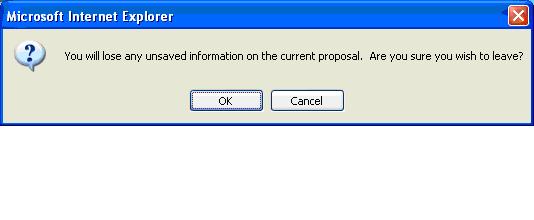
This is a typical modal for our application:

Here is the Winclicker set up method:
def startClicker( button , waitTime = 3)
w = WinClicker.new
longName = @ie.dir.gsub("/" , "\\" )
shortName = w.getShortFileName(longName)
c = "start rubyw #{shortName }\\watir\\clickJSDialog.rb #{button } #{ waitTime} "
puts "Starting #{c}"
w.winsystem(c)
w=nil
#assert_same(expected, actual, [message] ) #Expects expected.equal?(actual)
end
The real key to making this successful is the Winclicker call needs to be made prior to activating the link that leads to the modal.
Like this:
startClicker("OK" , 3)
@ie.link(:text, "Logout").click
Another important note is the value about, which indicates the amount of wait time. The wait time can be very important if there are several modals in a series of events. Timing is everything and you have to work to get WATIR to flow through the modals.
The second hurdle was pop-up utilities. Again the development team lent there expertise and we are able to get the attach method functional. The attach method using a second thread to control the pop-up.
One important thing to note is that when working over a VPN connection the attach method does not seem to work. This is the case for our VPN connection. The script will stop on any attach method over VPN, but runs fine when executed from the office. I have no clue as to why this is the case, but I find it frustrating.
After clicking on the link that exposes a pop-up utility, using the attach method you can then manipulate the data on the pop-up utility.
Example syntax:
@ie.link(:text, "ADD NEW...").click
@ie.link(:text, "CONNECTION").click
ie2 = IE.attach(:title, "Connection")
ie2.selectBox( :name , "connPort1").select("port 1")
ie2.image(:src , /ps_transferto_button/).click
ie2.selectBox( :name , "connPort2").select("port 0")
ie2.selectBox( :name , "connSitesAvailable2").select("002-TX-DAL")
ie2.link(:url, /connSitesAvailable2/).click
All of the input I received from the WATIR community is that there is room for improvement in the mechanisms for handling modals and pop-ups using WATIR, but for now I am running through the application.
One other side note is that supposedly an add-on to WATIR called WET does a better job handling modals and pop-ups. We were not able to get WET to work, but I am sure with more effort this would be an alternative solution.
After overcoming these challenges we have been able to successfully write approximately 80 test scripts, providing 23% automation of our current test cases.
Wednesday, November 09, 2005
Fortunately I landed a position with a start up company, who was test-driven and Agile. Here is where we implemented some extremely powerful methods using Webload. Webload was a terrific tool in that we could leverage performance tests as functional tests. We developed the testing methods almost as fast as the application was built. Sometime in 2002 Webload changed their application to be more GUI focused. The end result was this rendered many of our previously developed scripts almost useless. There were certain things we struggled with using 5.2 and these things were addressed in 6.0, but the trade off of redeveloping all of our scripts was huge. The bottom line was we never got back to the level of scripts we needed to be efficient at testing our product line application. In September of 2004, I decided to abandon Webload and continue our search for the Holy Grail of testing tools. I played with Open STA, Load Runner, and some emerging technology called WATIR, Web Application Testing in Ruby. Open STA was difficult to get off the ground. I do not recall the specifics, but it was quickly abandoned. I got a temporary license for using Load Runner. This was an awesome tool, but like other great tools came with a significant price tag. Well no sooner than I got my first WATIR script written I was again victim to a “reduction in force”.
I was fortunate and landed my current Gig. There was not much time early on for me to dive into test automation. I had to put my head to the grind stone and learn the testing environments and a robust application. My new mentor threw me to the wolves. The QA team was responsible for maintaining and configuring their test environment. My first challenge was to install AIX and get our application up and running. Definitely I felt like ex-prize fighter, Terry, the main character of “On the Water Front”. I took some serious blows, but after some hand holding I got it done. Now I just pray that the AIX machine does not crash! Once my domain knowledge was up to par, there was time for some automated test development. We were told to use an internal tool, Easy Test. This testing tool is content–driven using a table structure. It is really a powerful testing tool for both web and enterprise based applications. My two brain cells for the longest time just did not get it. I think the main reason was that I did not have the time to fully dive in and learn the tool. We were releasing a new product every 3-4 weeks, which left very little time for test automation. Once again there was a changing of the guard, but this time I was extremely fortunate to remain a member of a great Professional Services team. We developed a new application and right from the start we wanted to have test-driven development. WATIR was a logical choice.
The development team was excited about the potential of WATIR. We immediately hit a snag with WATIR’s ability to handle modals and pop ups. I struggled for a couple of weeks to no avail. I quickly abandoned WATIR and dove into Easy Test. Easy Test handled modals, pop ups, and even desktop file exchanges like a champion. I do not intend to do a line by line comparison of these two tools here, but I can summarize by saying I now have two very good weapons in my bag of tricks. My brain kept leading me back to WATIR. WATIR seemed to come more naturally to me. I still had not conquered the modal issue, so I asked a seasoned developer to take a look at it. In a couple of days she pointed out the flaws in my approach and I was back to using WATIR. Today we are using WATIR. As time permits I will share some additional challenges and thoughts on using WATIR as our main tool for functional testing. Most likely I will find time about once a week to post a thought or two on the trials and tribulations of WATIR.